
Case 002
Tenant Triage NYC
A free, open-source web guide for New York City tenants. It walks people through housing problems, generates the artifacts they need to act on them, and connects to live city data so they can check violations against their own building.
§00 · The brief
What Tenant Triage NYC is
New York City has some of the strongest tenant protections in the country, and most tenants do not know what they are. The resources that exist tend to fall into two camps: informational sites that explain rights without helping anyone act on them, and lookup tools that perform narrow searches without context. A tenant with mold at 11pm on a Sunday needs both: a clear next action, and the artifact to take it.
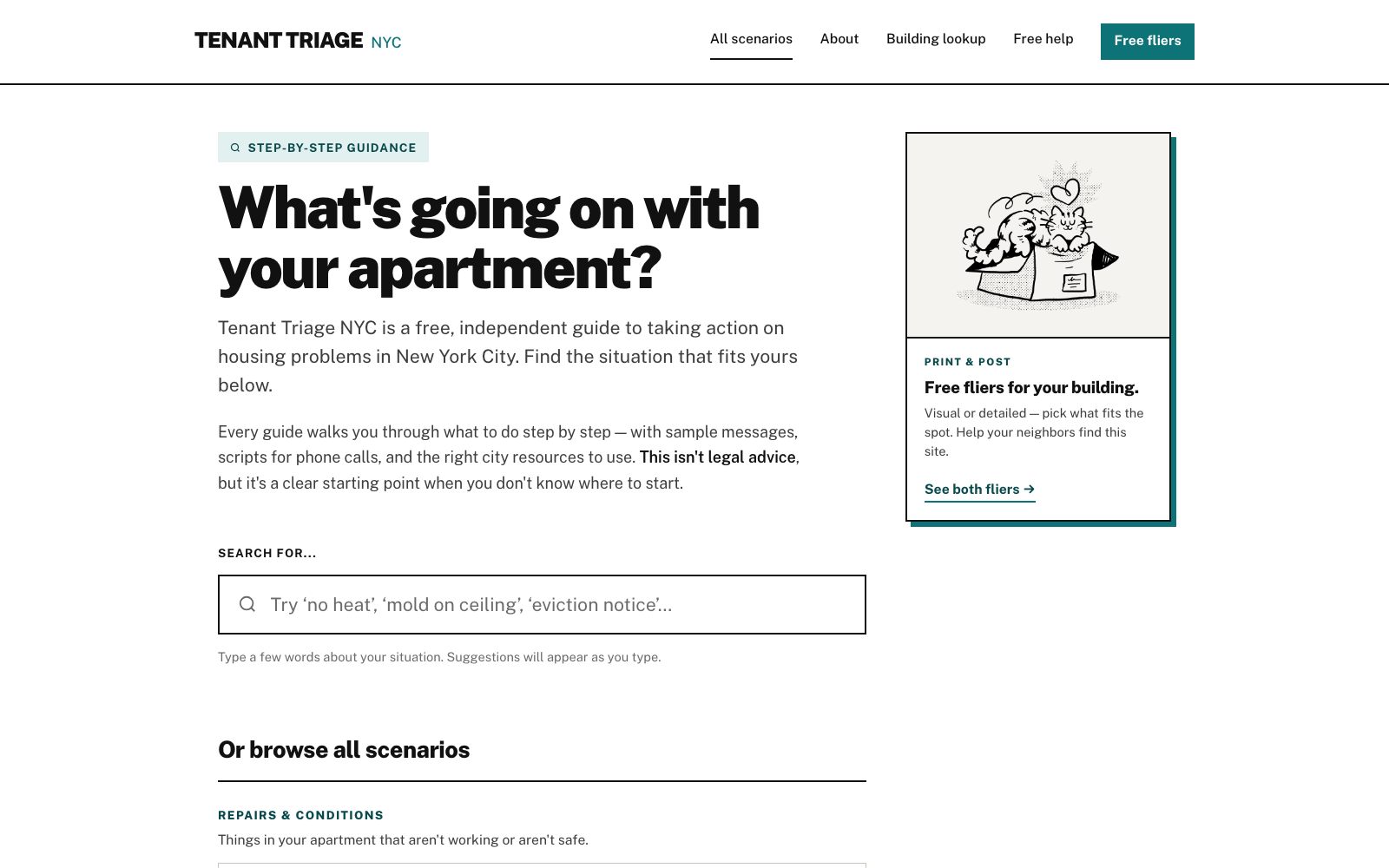
Tenant Triage NYC is a free, open-source web guide that closes that gap. It walks tenants through housing problems — mold, pests, no heat, leaks, broken appliances, lead paint — via step-by-step scenarios that adapt to their situation, generate fillable complaint templates, and connect to live city data so the tenant can check whether their building already has open violations.
The project grew out of tenant canvassing work in Brooklyn. The pattern Holly kept seeing was that tenants were not short on information, they were short on structured, actionable next steps that met them where they were: on their phone, stressed, often in a language or literacy context that made dense legal resources inaccessible.
A civic-tech tool for NYC tenants — designed and built solo, verified by housing hotline staff, and printable for a building lobby.
§01 · Design
Made for tenants under stress
Tenant Triage is not built for researchers. It is built for someone who is mid-problem and needs to take action. That meant designing the content as a sequence of structured actions, not as a legal explainer.
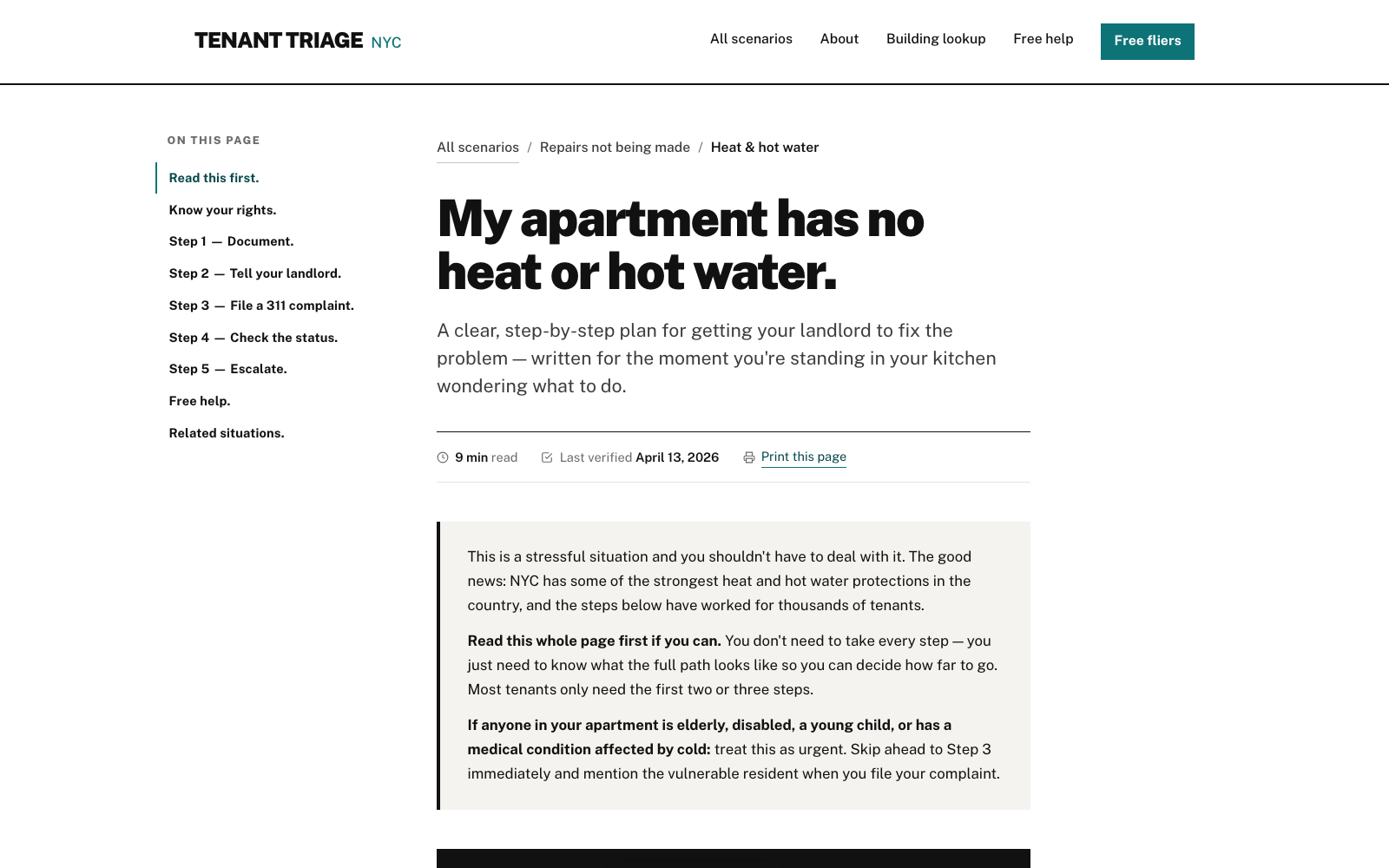
Holly designed a reusable 5-step skeleton that every housing problem follows: document the issue, notify the landlord in writing, file a 311 or HPD complaint, check a violation status, and escalate things when necessary. Standardizing the skeleton means scenarios can be branched and expanded without the information architecture drifting, and a tenant who learns the pattern once can navigate any new scenario.
Pest scenarios behave differently depending on whether you have mice, bedbugs, or roaches: different legal classifications, different timelines, different actions. Rather than write six separate guides, Holly built type pickers that tailor the guide in place. The same pattern applies to mold severity, heat-season dates, and lease type.
Tenants filing complaints also don’t have to repeat the same information across multiple artifacts; the building address, the date the issue started, the complaint number returned by HPD. A cross-page field-syncing system means a tenant enters their information once and it auto-populates into every email, phone script, and reference lookup.
§02 · Engineering
Live data, no backend
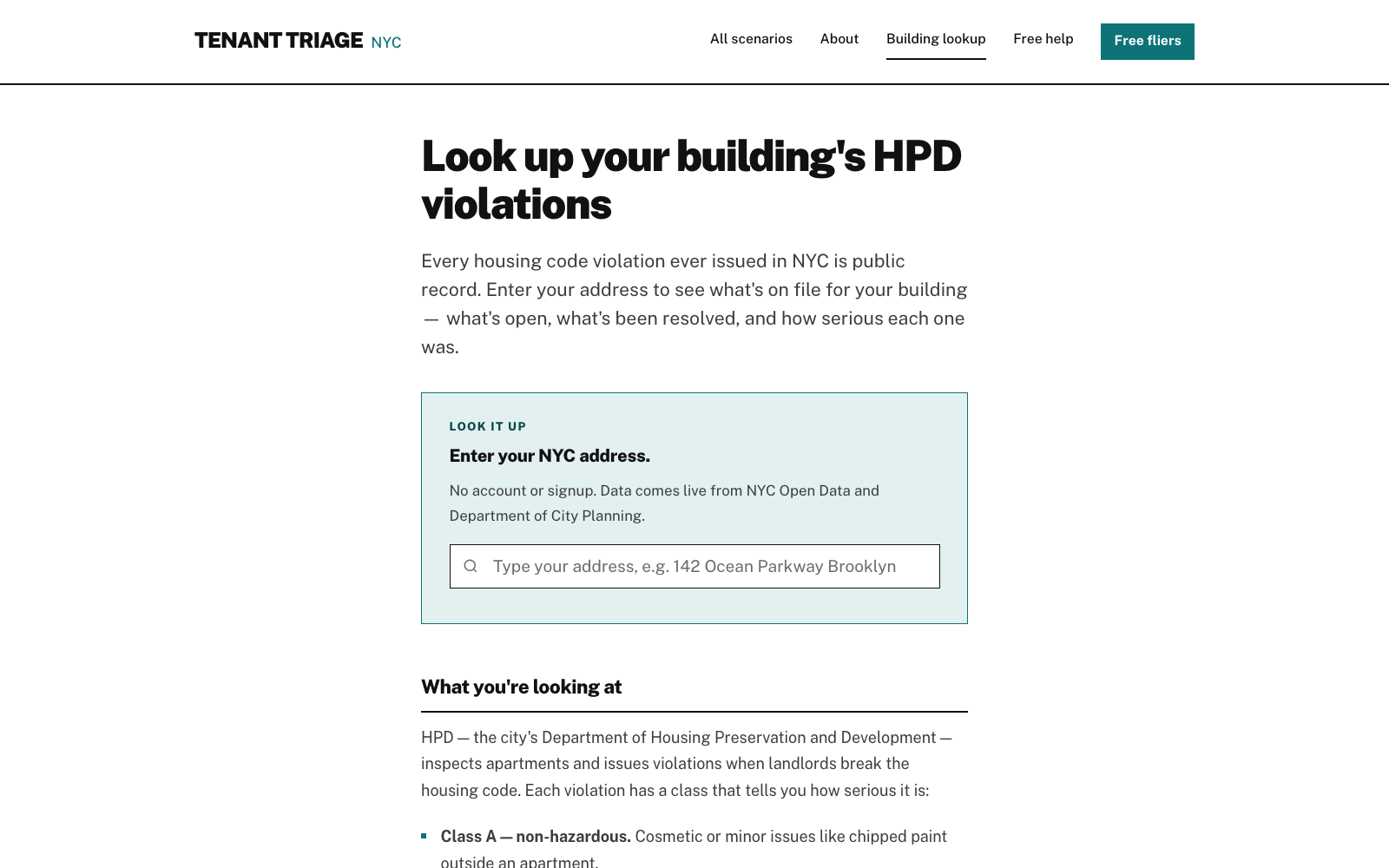
The HPD violation lookup chains two free public NYC APIs — Planning Labs GeoSearch for address autocomplete, Open Data Socrata for HPD Housing Maintenance Code violations — and runs entirely in the browser. No server, no auth, no hosting cost. The tool is fast, free to operate, and easy to keep online indefinitely.
Holly built a translation layer that converts HPD’s internal jargon (“NOV SENT OUT”) into plain English (“Notice sent to landlord”), a parser that strips legal citation prefixes from violation descriptions to surface the plain-English action item, and a sentence-case converter that preserves ~30 known acronyms. Progressive loading keeps the interface responsive for buildings with extensive violation histories.
Maps to: Engineering and infrastructure
§03 · How it was made
One designer-builder, with help
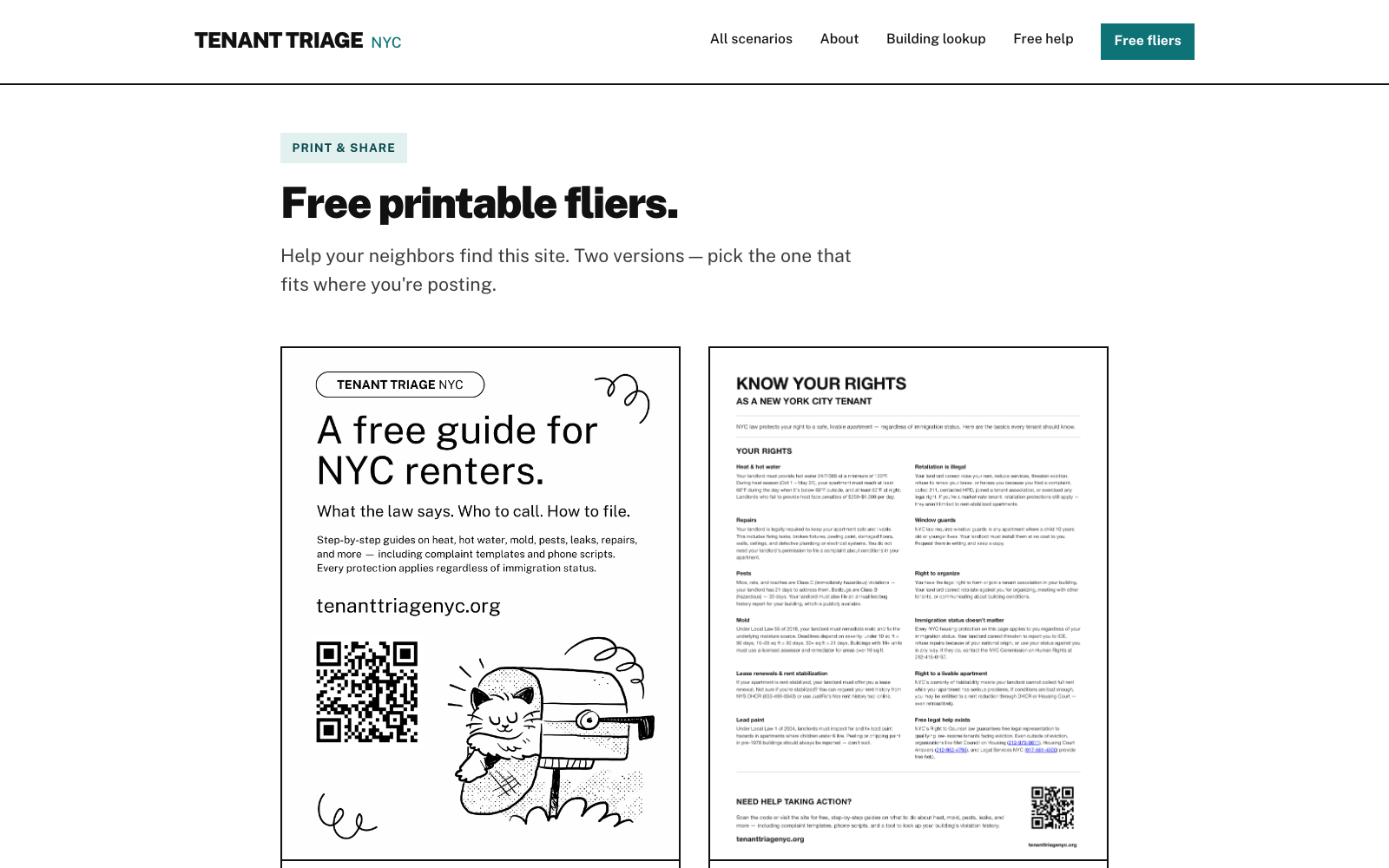
Holly designed and built Tenant Triage end-to-end, with feedback and collaboration from Liam. When Holly shared the live site, Liam suggested making a printable flyer — something a tenant or organizer could tape up in a building lobby. Holly made two: a detailed breakdown that explains what the site does and the steps for the most common housing problems, and a simpler one with an illustration, a one-line description, and a QR code. Both are at tenanttriagenyc.org/fliers.html.
The legal accuracy bar for a tenants’ rights tool is unforgiving. Wrong information could send someone down the wrong enforcement path, or worse, undermine their case. To hold the bar, Holly reached out to her friend Angela, who has been involved with the Met Council on Housing for a decade. Angela connected Holly with people who work for the housing hotline, and they verified the steps and the underlying information, scenario by scenario, before any of it went in front of users.
Unverified legal claims carry visible [VERIFY] tags directly in the source, so reviewers can work in the HTML rather than a separate tracking system. The tags are visible to users too — the site is honest about what has been reviewed and what is pending.
Maps to: Service design·Documentation
§04 · Where it is
Live, and open source
Tenant Triage is live at tenanttriagenyc.org. V1 shipped with ten scenario guides (heat and hot water, mold, pests, leaks and plumbing, broken appliances, lead paint, repairs not getting fixed, retaliation, lease non-renewal, and eviction notices), the HPD violation lookup tool, a room-by-room walkthrough, a free legal help directory, and two printable flyers.
The project is open source and designed for adoption by tenant organizations and legal aid providers as a citable resource. It’s shareable as a URL, findable via search, usable on a phone in a hallway outside housing court.
§05 · A look
Selected screens
Building a civic-tech tool, or a product that has to be honest about what it knows? Tell us about it.